Odd-form component mounter

Odd-form component mounter
Improve product quality and increase production capacity solution.

odd-form solutions are designed for high volume and high mix production. Odd-form process automation is an efficient way to improve profitability significantly by increasing the throughput and assembly quality.
The benefits can be measured in assembly reliability, accuracy and flexibility, labor savings, assembly yield improvements, floor space savings and optimization of processes.

Are you finding the automatic nozzles cleaner?We can provide!

nozzles cleaner

In the process of SMT, the suction nozzle is quite easily adhered with solder paste or dirt etc. If maintenance has not been done for a long time or the cleaning is not thorough enough while maintaining it, the paste and dirt will be hardened so as to increase the difficulty of cleaning, even it will result in blockage and scraps after long-time accumulation. It practically proves that the S-U24cleaning machine can effectively deal with inflexible solder paste and thoroughly clean the suction nozzle with complex structure.


Equipment size     L× W×H (mm) 505 ×570 ×500
Equipment weight quality 70KG
Cleaning liquor   Cleaning liquor type Industrial purify water
consumption 400CC/H
Liquid used Air source Compressed air
Pressure range 0.5 -0.6Mpa(While cleaning)
Jet pressure 0.4Mpa
Air consumption 280NL/min.or less
Power Voltage AC200-240V
Rated power consumption Max. 200W
Suction nozzle tray Specification Default 24 positions
Object to be cleaned Mounting nozzle  01005-2125

Are You Finding the Odd Form Components Machine?

We designed and manufactured Auto Insertion machine in Shenzhen China, — Decreasing labor cost — Easier manufacturing and operations management — Predictable Product Quality – Less repairs — No wrong parts nor wrong polarity — Less risk of damage due to human contact (contamination, ESD, physical damage to components) — Better clinching, less risk of solder issues. — Smaller factory space required to produce same volume of product.

Odd-form components are the only remaining discrete components left to hand assessmbly of a Printed Circuit Board.

The reasons are many,but the fundamental reason is that there are no standards that govern the shape,lead count,packaging,etc.Therefore,most manufacturers are left to handle the components as a special request for proposal and address the problem with a very customized platform.

Our odd components machine is one of the best automation machine for the job can handle components ranging from a 0.01“single pin to a 12”square block if required and do it without tool change or at least an automatic tool change.

This machine also be equipped with vision to inspect the leads and the top of the device for orientation or even position correction.


What special shaped components can be used in the Odd-form Comeponent Mounter?

we are professional in this project ,not only just 2or 3 parts . we can install 6 to 48 feeder ,If you have some non-standard shaped components required to complete the machine, you can give us to help you solve.

Machine advantage
1.High return of machines investment
2.Labour saving
3.reduce the related labor costs
4.Keep workmanship consistent with quality
5.Improve the capacity and reliability
6.Space saving

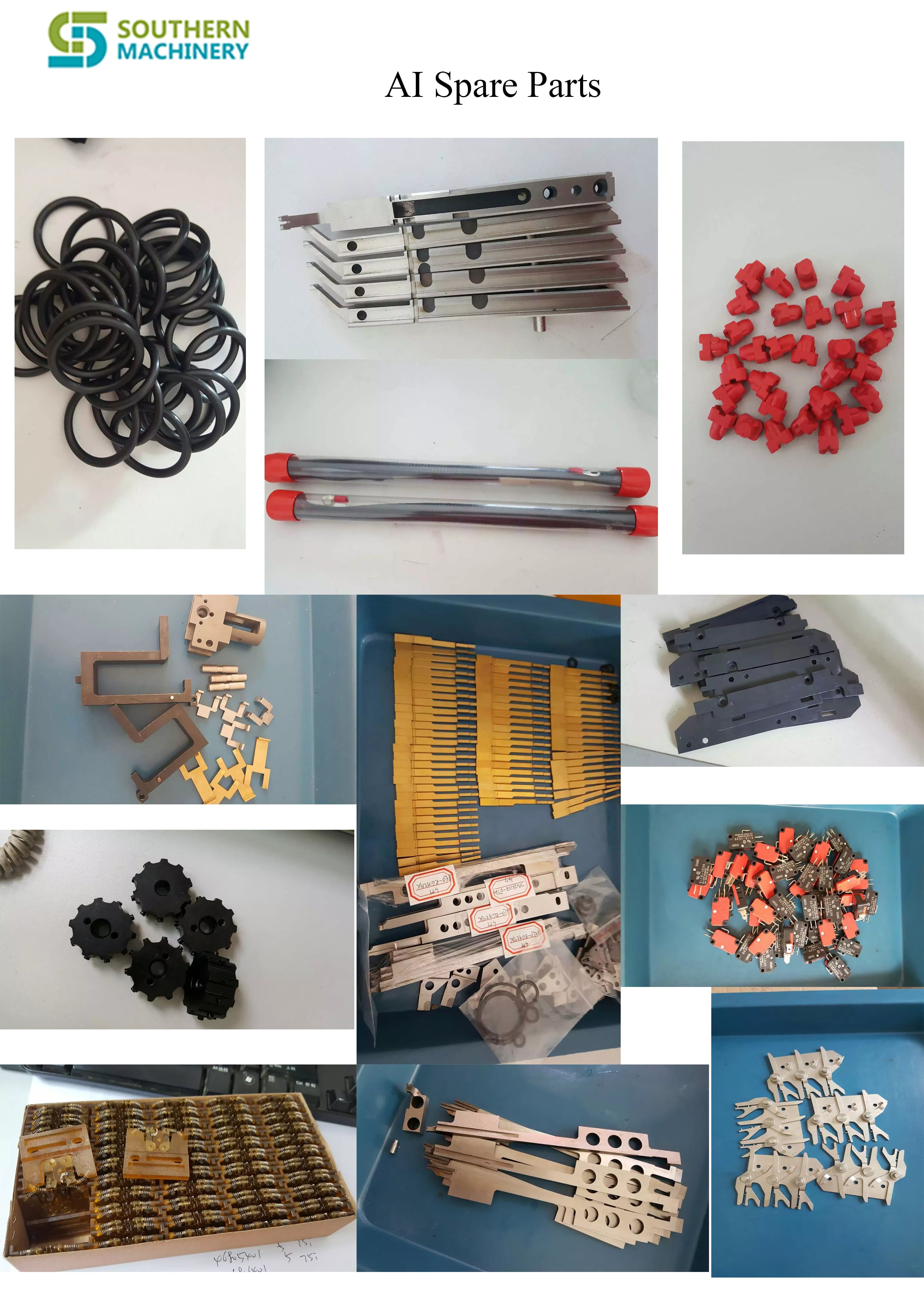
Carrier clips — UIC Spare parts for Auto Insertion Machine

Carrier Clip is the very common wearing parts in Radial insertion machine. We manufacture the high copy spare parts , promise the quality and keep low cost .

Insert radial components by a chip mounter, how to realize?

How to realize inserting radial components in a chip mounter?

Normally , chip mounters are used to pick and place SMD components . But if you want to use your chip mounter to insert the radial components ,it is allowed also.

S-RF1001 The through-hole feeder for mounter *The S-RF1001 is a revolutionary new concept from Southern Machinery that allow the placement or insertion of both surface mount and through-hole components. Can adaptive most of mounter.

*We use the special way to modify feeder, can achieve Fuji, Juki, YAMAHA, MYDATA and other machine brands to insert the radial components.
CLICK HERE TO SEND ME A EMAIL

CLICK HERE TO SEND ME A EMAIL

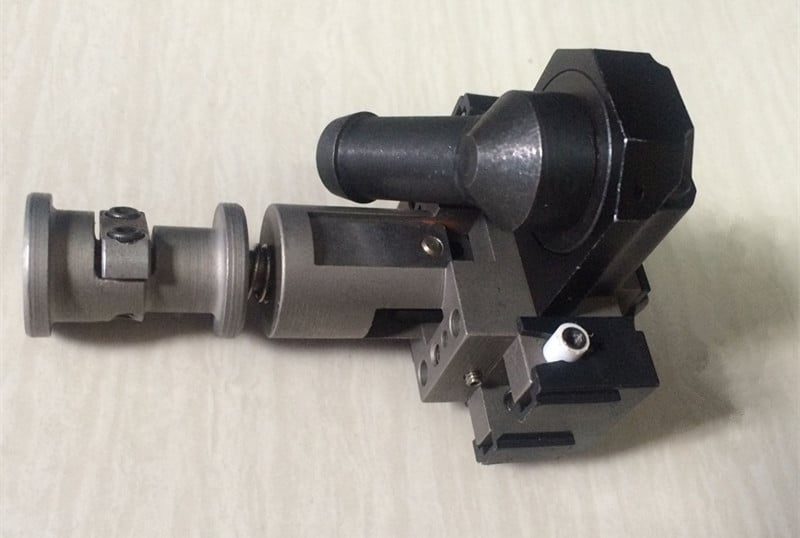
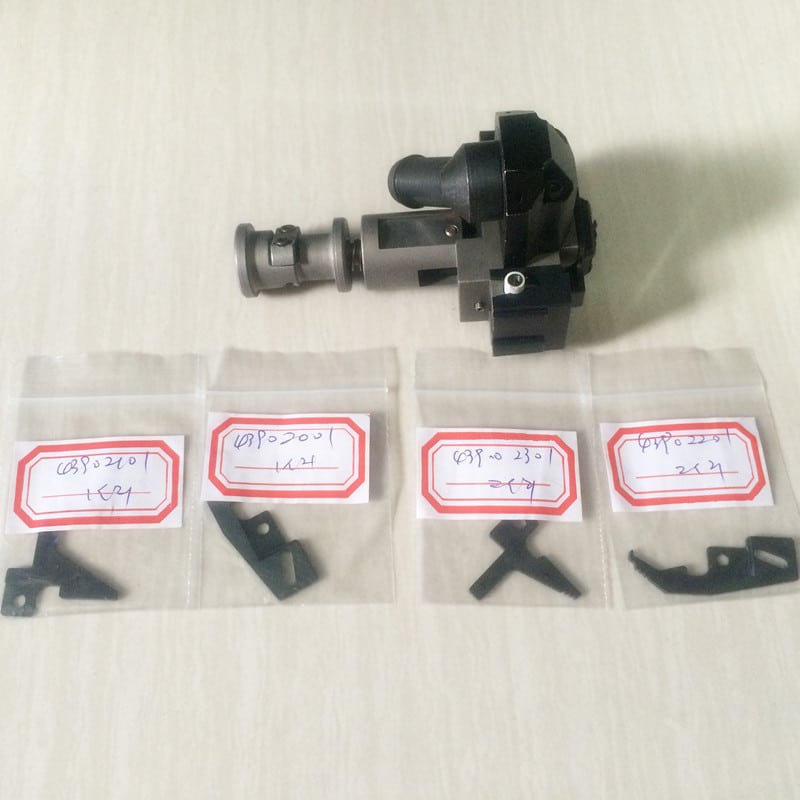
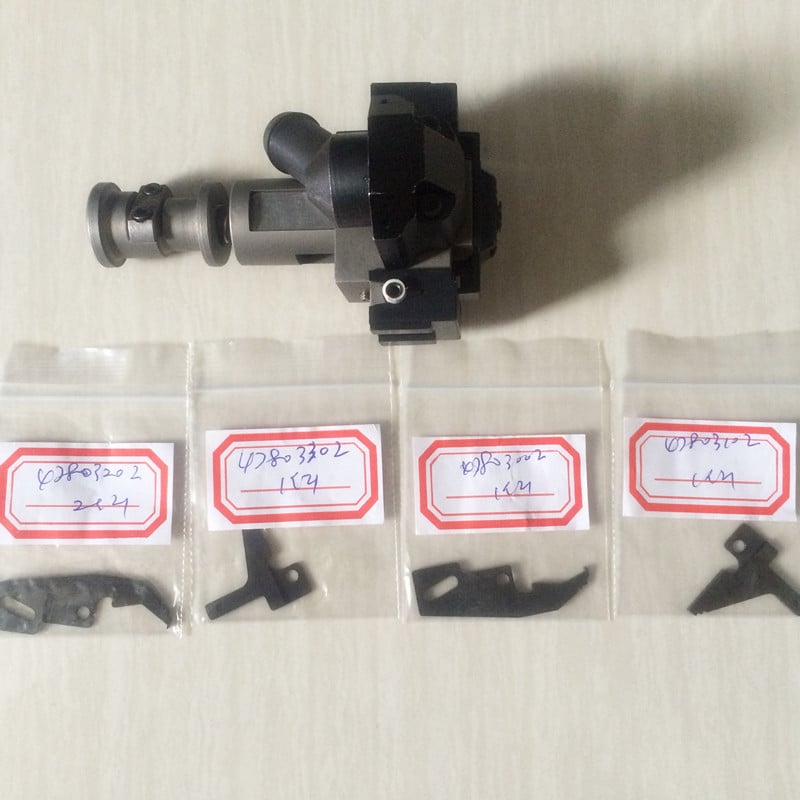
UIC axial insertion.ai spare parts offset cutter

剪脚头

1.Different types of the Cutter, and also can provide 2.5 special cut foot

  1. According to the requirements ,we can adjust to introvert,solve the problem of Angle     element density
  2. Provide different kinds of blades

  3. Provide matching accessories and vulnerable parts

Product details:

剪脚头和剪脚刀剪脚头和剪脚刀1


We design and manufacture spare parts of most kinds of auto insertion machine or SMT equipment,which high quality and low overhead.
And we provide different spare parts and wearing parts of different brands and models(UIC,TDK,Panasonic,Samsung,Fuji,Juki,etc)Only need to tell us your parts‘machine model and /N.

Welcome to inquiry:quella@smthelp.net

Skype:fan19920311


AI/SMT spare parts

Profesional in AI/SMT machine and spare parts of AI/SMT .
1.We have original drawing ,what we can make is almost  the same quality with original spare parts.
2.All the process when manufactured ,our engineer would give guide and test the quality.
3.Only when the qulity is passed will we let the parts into our store.
4.Also we can control our spare parts in a very low price, when control it on a good quality.

AI accessaries4UEDF(J45NAM7Z9K`_OX{N6

One key point to consider Radial machine spare parts design and manufacturing

Reels or ammo packs of radial leaded components are loaded on the sequencer module, dispensed, and inserted in the PCB following the programmed sequence. Component dispensing heads remove components from the carrier tape and place them in component carrier clips located on the sequencer chain assembly. The sequencer chain assembly transports the components to the insertion area. While the components are on the sequencer chain assembly, the carrier tape is removed. The component transfer assembly transfers components from the sequencer chain assembly into the insertion head tooling. The insertion tooling guides the leads through the holes in the PC board. The cut and clinch unit cuts and then forms the leads, securing the component in the PC board.

How does SMT electronics assembly work?

Electronics manufacturing using surface-mount technology (SMT) simply means that electronic components are assembled with automated machines that place components on the surface of a board (printed circuit board, PCB).

SMT车间

Electronics manufacturing using surface-mount technology (SMT) simply means that electronic components are assembled with automated machines that place components on the surface of a board (printed circuit board, PCB). In contrast to conventional through-hole technology (THT) processes, SMT components are placed directly on the surface of a PCB instead of being soldered to a wire lead. When it comes to electronic assembly, SMT is the most frequently used process in the industry.

Electronic assembly encompasses not only placing and soldering components to the PCB, but also the following production steps:

  • Applying soldering paste, which is made of tin particles and flux, to the PCB
  • Placing SMT components to the soldering paste on the PCB
  • Soldering the boards with a reflow process.

Applying Soldering Paste

Applying soldering paste is one of the first steps in the SMT assembly process. Soldering paste is “printed” on the boards using the silk-screen method. Depending on the design of the board, different stainless-steel stencils for “printing” the paste onto the board and various product-specific pastes are used. Using a laser cut stainless-steel stencil custom made for the project, the soldering paste to be applied only to the areas where components will be soldered. After the soldering paste is on the boards, a 2D-soldering paste inspection is performed to ensure that the paste is evenly and correctly applied. Once the accuracy of the soldering paste application has been confirmed, the boards are transferred to the SMT assembly line, where the components will be soldered.

AI spare parts、Universal Parts,UIC,TDK.VCD Sequencer.SMT,THT,PCB,PCBA,AI,wave soldering,reflow oven,nozzle,feeder,wave soldering,PCB Assembly, LED, LED lamp, LED display AI spare parts、Universal Parts,UIC,TDK.VCD Sequencer.SMT,THT,PCB,PCBA,AI,wave soldering,reflow oven,nozzle,feeder,wave soldering,PCB Assembly, LED, LED lamp, LED display

Component  Placement and Assembly

The electronic components to be assembled come in trays or reels, which are then loaded into the SMT machine. During the loading process, intelligent software systems ensure that components are not inadvertently switched or misloaded. The SMT assembly machine then automatically removes each component with a vacuum pipette from its tray or reel and places it on its correct position on the board using precise pre-programmed X-Y coordinates. Our machines are capable of assembling up to 25,000 components per hour. After the SMT assembly is completed, the boards are moved on to the Reflow ovens for soldering, which affixes the components to the board.

S-320 pick&place machine

SMT line

Component Soldering

To solder electronic components, we use two different methods, each of which has distinct advantages depending on the order quantity. For series production orders, the Reflow-soldering process is used. During this process, boards are put in a nitrogen atmosphere and are gradually warmed up with heated air until the soldering paste melts and the flux vaporizes, which fuses the components to the PCB. After this stage, the boards are cooled off. As the tin in the soldering paste hardens, the components become permanently affixed to the board and the SMT assembly process is completed.

For prototypes or highly sensitive components, we have a specialized vapor-phase soldering process. In this process, boards are heated until the specific melting point (Galden) of the soldering paste is reached. This allows us to solder at lower temperatures or solder different SMT components at different temperatures depending on their individual soldering temperature profiles.

PastedGraphic-59

AOI and Visual Check

Soldering is the second-to-last step of the SMT assembly process. In order to ensure the quality of the assembled boards, or to catch and correct a mistake, AOI visual inspections are performed for almost all series production orders. Using several cameras, the AOI system automatically checks each board and compares the appearance of each board with the correct, pre-defined reference image. If there are any deviations, the operator of the machine is informed of the potential problem, who then corrects the mistake or pulls the board from the machine for further inspection. The AOI visual check ensures consistency and accuracy in the SMT assembly production process.


Dimensons_floor _layout - A_cmyk