The following is the full text of an action plan on the China-proposed Belt and Road Initiative issued by the National Development and Reform Commission, Ministry of Foreign Affairs, and Ministry of Commerce of the People’s Republic of China, with State Council authorization, on Saturday.
Vision and proposed actions outlined on jointly building Silk Road Economic Belt and 21st-Century Maritime Silk Road
Preface
More than two millennia ago the diligent and courageous people of Eurasia explored and opened up several routes of trade and cultural exchanges that linked the major civilizations of Asia, Europe and Africa, collectively called the Silk Road by later generations. For thousands of years, the Silk Road Spirit – “peace and cooperation, openness and inclusiveness, mutual learning and mutual benefit” – has been passed from generation to generation, promoted the progress of human civilization, and contributed greatly to the prosperity and development of the countries along the Silk Road. Symbolizing communication and cooperation between the East and the West, the Silk Road Spirit is a historic and cultural heritage shared by all countries around the world.
In the 21st century, a new era marked by the theme of peace, development, cooperation and mutual benefit, it is all the more important for us to carry on the Silk Road Spirit in face of the weak recovery of the global economy, and complex international and regional situations.
When Chinese President Xi Jinping visited Central Asia and Southeast Asia in September and October of 2013, he raised the initiative of jointly building the Silk Road Economic Belt and the 21st-Century Maritime Silk Road (hereinafter referred to as the Belt and Road), which have attracted close attention from all over the world. At the China-ASEAN Expo in 2013, Chinese Premier Li Keqiang emphasized the need to build the Maritime Silk Road oriented toward ASEAN, and to create strategic propellers for hinterland development. Accelerating the building of the Belt and Road can help promote the economic prosperity of the countries along the Belt and Road and regional economic cooperation, strengthen exchanges and mutual learning between different civilizations, and promote world peace and development. It is a great undertaking that will benefit people around the world.
The Belt and Road Initiative is a systematic project, which should be jointly built through consultation to meet the interests of all, and efforts should be made to integrate the development strategies of the countries along the Belt and Road. The Chinese government has drafted and published the Vision and Actions on Jointly Building Silk Road Economic Belt and 21st-Century Maritime Silk Road to promote the implementation of the Initiative, instill vigor and vitality into the ancient Silk Road, connect Asian, European and African countries more closely and promote mutually beneficial cooperation to a new high and in new forms.
I. Background
Complex and profound changes are taking place in the world. The underlying impact of the international financial crisis keeps emerging; the world economy is recovering slowly, and global development is uneven; the international trade and investment landscape and rules for multilateral trade and investment are undergoing major adjustments; and countries still face big challenges to their development. The initiative to jointly build the Belt and Road, embracing the trend toward a multipolar world, economic globalization, cultural diversity and greater IT application, is designed to uphold the global free trade regime and the open world economy in the spirit of open regional cooperation. It is aimed at promoting orderly and free flow of economic factors, highly efficient allocation of resources and deep integration of markets; encouraging the countries along the Belt and Road to achieve economic policy coordination and carry out broader and more in-depth regional cooperation of higher standards; and jointly creating an open, inclusive and balanced regional economic cooperation architecture that benefits all. Jointly building the Belt and Road is in the interests of the world community. Reflecting the common ideals and pursuit of human societies, it is a positive endeavor to seek new models of international cooperation and global governance, and will inject new positive energy into world peace and development.
The Belt and Road Initiative aims to promote the connectivity of Asian, European and African continents and their adjacent seas, establish and strengthen partnerships among the countries along the Belt and Road, set up all-dimensional, multitiered and composite connectivity networks, and realize diversified, independent, balanced and sustainable development in these countries. The connectivity projects of the Initiative will help align and coordinate the development strategies of the countries along the Belt and Road, tap market potential in this region, promote investment and consumption, create demands and job opportunities, enhance people-to-people and cultural exchanges, and mutual learning among the peoples of the relevant countries, and enable them to understand, trust and respect each other and live in harmony, peace and prosperity.
China’s economy is closely connected with the world economy. China will stay committed to the basic policy of opening-up, build a new pattern of all-around opening-up, and integrate itself deeper into the world economic system. The Initiative will enable China to further expand and deepen its opening-up, and to strengthen its mutually beneficial cooperation with countries in Asia, Europe and Africa and the rest of the world. China is committed to shouldering more responsibilities and obligations within its capabilities, and making greater contributions to the peace and development of mankind.
II. Principles
The Belt and Road Initiative is in line with the purposes and principles of the UN Charter. It upholds the Five Principles of Peaceful Coexistence: mutual respect for each other’s sovereignty and territorial integrity, mutual nonaggression, mutual noninterference in each other’s internal affairs, equality and mutual benefit, and peaceful coexistence.
The Initiative is open for cooperation. It covers, but is not limited to, the area of the ancient Silk Road. It is open to all countries, and international and regional organizations for engagement, so that the results of the concerted efforts will benefit wider areas.
The Initiative is harmonious and inclusive. It advocates tolerance among civilizations, respects the paths and modes of development chosen by different countries, and supports dialogues among different civilizations on the principles of seeking common ground while shelving differences and drawing on each other’s strengths, so that all countries can coexist in peace for common prosperity.
The Initiative follows market operation. It will abide by market rules and international norms, give play to the decisive role of the market in resource allocation and the primary role of enterprises, and let the governments perform their due functions.
The Initiative seeks mutual benefit. It accommodates the interests and concerns of all parties involved, and seeks a conjunction of interests and the “biggest common denominator” for cooperation so as to give full play to the wisdom and creativity, strengths and potentials of all parties.
III. Framework
The Belt and Road Initiative is a way for win-win cooperation that promotes common development and prosperity and a road toward peace and friendship by enhancing mutual understanding and trust, and strengthening all-around exchanges. The Chinese government advocates peace and cooperation, openness and inclusiveness, mutual learning and mutual benefit. It promotes practical cooperation in all fields, and works to build a community of shared interests, destiny and responsibility featuring mutual political trust, economic integration and cultural inclusiveness.
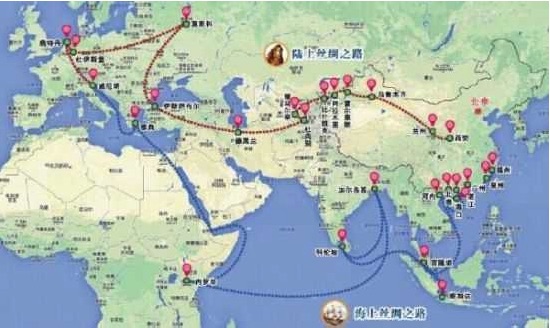
The Belt and Road run through the continents of Asia, Europe and Africa, connecting the vibrant East Asia economic circle at one end and developed European economic circle at the other, and encompassing countries with huge potential for economic development. The Silk Road Economic Belt focuses on bringing together China, Central Asia, Russia and Europe (the Baltic); linking China with the Persian Gulf and the Mediterranean Sea through Central Asia and West Asia; and connecting China with Southeast Asia, South Asia and the Indian Ocean. The 21st-Century Maritime Silk Road is designed to go from China’s coast to Europe through the South China Sea and the Indian Ocean in one route, and from China’s coast through the South China Sea to the South Pacific in the other.
On land, the Initiative will focus on jointly building a new Eurasian Land Bridge and developing China-Mongolia-Russia, China-Central Asia-West Asia and China-Indochina Peninsula economic corridors by taking advantage of international transport routes, relying on core cities along the Belt and Road and using key economic industrial parks as cooperation platforms. At sea, the Initiative will focus on jointly building smooth, secure and efficient transport routes connecting major sea ports along the Belt and Road. The China-Pakistan Economic Corridor and the Bangladesh-China-India-Myanmar Economic Corridor are closely related to the Belt and Road Initiative, and therefore require closer cooperation and greater progress.
The Initiative is an ambitious economic vision of the opening-up of and cooperation among the countries along the Belt and Road. Countries should work in concert and move toward the objectives of mutual benefit and common security. To be specific, they need to improve the region’s infrastructure, and put in place a secure and efficient network of land, sea and air passages, lifting their connectivity to a higher level; further enhance trade and investment facilitation, establish a network of free trade areas that meet high standards, maintain closer economic ties, and deepen political trust; enhance cultural exchanges; encourage different civilizations to learn from each other and flourish together; and promote mutual understanding, peace and friendship among people of all countries.
IV. Cooperation Priorities
Countries along the Belt and Road have their own resource advantages and their economies are mutually complementary. Therefore, there is a great potential and space for cooperation. They should promote policy coordination, facilities connectivity, unimpeded trade, financial integration and people-to-people bonds as their five major goals, and strengthen cooperation in the following key areas:
Policy coordination
Enhancing policy coordination is an important guarantee for implementing the Initiative. We should promote intergovernmental cooperation, build a multilevel intergovernmental macro policy exchange and communication mechanism, expand shared interests, enhance mutual political trust, and reach new cooperation consensus. Countries along the Belt and Road may fully coordinate their economic development strategies and policies, work out plans and measures for regional cooperation, negotiate to solve cooperation-related issues, and jointly provide policy support for the implementation of practical cooperation and large-scale projects.
Facilities connectivity
Facilities connectivity is a priority area for implementing the Initiative. On the basis of respecting each other’s sovereignty and security concerns, countries along the Belt and Road should improve the connectivity of their infrastructure construction plans and technical standard systems, jointly push forward the construction of international trunk passageways, and form an infrastructure network connecting all subregions in Asia, and between Asia, Europe and Africa step by step. At the same time, efforts should be made to promote green and low-carbon infrastructure construction and operation management, taking into full account the impact of climate change on the construction.
With regard to transport infrastructure construction, we should focus on the key passageways, junctions and projects, and give priority to linking up unconnected road sections, removing transport bottlenecks, advancing road safety facilities and traffic management facilities and equipment, and improving road network connectivity. We should build a unified coordination mechanism for whole-course transportation, increase connectivity of customs clearance, reloading and multimodal transport between countries, and gradually formulate compatible and standard transport rules, so as to realize international transport facilitation. We should push forward port infrastructure construction, build smooth land-water transportation channels, and advance port cooperation; increase sea routes and the number of voyages, and enhance information technology cooperation in maritime logistics. We should expand and build platforms and mechanisms for comprehensive civil aviation cooperation, and quicken our pace in improving aviation infrastructure.
We should promote cooperation in the connectivity of energy infrastructure, work in concert to ensure the security of oil and gas pipelines and other transport routes, build cross-border power supply networks and power-transmission routes, and cooperate in regional power grid upgrading and transformation.
We should jointly advance the construction of cross-border optical cables and other communications trunk line networks, improve international communications connectivity, and create an Information Silk Road. We should build bilateral cross-border optical cable networks at a quicker pace, plan transcontinental submarine optical cable projects, and improve spatial (satellite) information passageways to expand information exchanges and cooperation.
Unimpeded trade
Investment and trade cooperation is a major task in building the Belt and Road. We should strive to improve investment and trade facilitation, and remove investment and trade barriers for the creation of a sound business environment within the region and in all related countries. We will discuss with countries and regions along the Belt and Road on opening free trade areas so as to unleash the potential for expanded cooperation.
Countries along the Belt and Road should enhance customs cooperation such as information exchange, mutual recognition of regulations, and mutual assistance in law enforcement; improve bilateral and multilateral cooperation in the fields of inspection and quarantine, certification and accreditation, standard measurement, and statistical information; and work to ensure that the WTO Trade Facilitation Agreement takes effect and is implemented. We should improve the customs clearance facilities of border ports, establish a “single-window” in border ports, reduce customs clearance costs, and improve customs clearance capability. We should increase cooperation in supply chain safety and convenience, improve the coordination of cross-border supervision procedures, promote online checking of inspection and quarantine certificates, and facilitate mutual recognition of Authorized Economic Operators. We should lower non-tariff barriers, jointly improve the transparency of technical trade measures, and enhance trade liberalization and facilitation.
We should expand trading areas, improve trade structure, explore new growth areas of trade, and promote trade balance. We should make innovations in our forms of trade, and develop cross-border e-commerce and other modern business models. A service trade support system should be set up to consolidate and expand conventional trade, and efforts to develop modern service trade should be strengthened. We should integrate investment and trade, and promote trade through investment.
We should speed up investment facilitation, eliminate investment barriers, and push forward negotiations on bilateral investment protection agreements and double taxation avoidance agreements to protect the lawful rights and interests of investors.
We should expand mutual investment areas, deepen cooperation in agriculture, forestry, animal husbandry and fisheries, agricultural machinery manufacturing and farm produce processing, and promote cooperation in marine-product farming, deep-sea fishing, aquatic product processing, seawater desalination, marine biopharmacy, ocean engineering technology, environmental protection industries, marine tourism and other fields. We should increase cooperation in the exploration and development of coal, oil, gas, metal minerals and other conventional energy sources; advance cooperation in hydropower, nuclear power, wind power, solar power and other clean, renewable energy sources; and promote cooperation in the processing and conversion of energy and resources at or near places where they are exploited, so as to create an integrated industrial chain of energy and resource cooperation. We should enhance cooperation in deep-processing technology, equipment and engineering services in the fields of energy and resources.
We should push forward cooperation in emerging industries. In accordance with the principles of mutual complementarity and mutual benefit, we should promote in-depth cooperation with other countries along the Belt and Road in new-generation information technology, biotechnology, new energy technology, new materials and other emerging industries, and establish entrepreneurial and investment cooperation mechanisms.
We should improve the division of labor and distribution of industrial chains by encouraging the entire industrial chain and related industries to develop in concert; establish R&D, production and marketing systems; and improve industrial supporting capacity and the overall competitiveness of regional industries. We should increase the openness of our service industry to each other to accelerate the development of regional service industries. We should explore a new mode of investment cooperation, working together to build all forms of industrial parks such as overseas economic and trade cooperation zones and cross-border economic cooperation zones, and promote industrial cluster development. We should promote ecological progress in conducting investment and trade, increase cooperation in conserving eco-environment, protecting biodiversity, and tackling climate change, and join hands to make the Silk Road an environment-friendly one.
We welcome companies from all countries to invest in China, and encourage Chinese enterprises to participate in infrastructure construction in other countries along the Belt and Road, and make industrial investments there. We support localized operation and management of Chinese companies to boost the local economy, increase local employment, improve local livelihoods, and take social responsibilities in protecting local biodiversity and eco-environment.
Financial integration
Financial integration is an important underpinning for implementing the Belt and Road Initiative. We should deepen financial cooperation, and make more efforts in building a currency stability system, investment and financing system and credit information system in Asia. We should expand the scope and scale of bilateral currency swap and settlement with other countries along the Belt and Road, open and develop the bond market in Asia, make joint efforts to establish the Asian Infrastructure Investment Bank and BRICS New Development Bank, conduct negotiation among related parties on establishing Shanghai Cooperation Organization (SCO) financing institution, and set up and put into operation the Silk Road Fund as early as possible. We should strengthen practical cooperation of China-ASEAN Interbank Association and SCO Interbank Association, and carry out multilateral financial cooperation in the form of syndicated loans and bank credit. We will support the efforts of governments of the countries along the Belt and Road and their companies and financial institutions with good credit-rating to issue Renminbi bonds in China. Qualified Chinese financial institutions and companies are encouraged to issue bonds in both Renminbi and foreign currencies outside China, and use the funds thus collected in countries along the Belt and Road.
We should strengthen financial regulation cooperation, encourage the signing of MOUs on cooperation in bilateral financial regulation, and establish an efficient regulation coordination mechanism in the region. We should improve the system of risk response and crisis management, build a regional financial risk early-warning system, and create an exchange and cooperation mechanism of addressing cross-border risks and crisis. We should increase cross-border exchange and cooperation between credit investigation regulators, credit investigation institutions and credit rating institutions. We should give full play to the role of the Silk Road Fund and that of sovereign wealth funds of countries along the Belt and Road, and encourage commercial equity investment funds and private funds to participate in the construction of key projects of the Initiative.
People-to-people bond
People-to-people bond provides the public support for implementing the Initiative. We should carry forward the spirit of friendly cooperation of the Silk Road by promoting extensive cultural and academic exchanges, personnel exchanges and cooperation, media cooperation, youth and women exchanges and volunteer services, so as to win public support for deepening bilateral and multilateral cooperation.
We should send more students to each other’s countries, and promote cooperation in jointly running schools. China provides 10,000 government scholarships to the countries along the Belt and Road every year. We should hold culture years, arts festivals, film festivals, TV weeks and book fairs in each other’s countries; cooperate on the production and translation of fine films, radio and TV programs; and jointly apply for and protect World Cultural Heritage sites. We should also increase personnel exchange and cooperation between countries along the Belt and Road.
We should enhance cooperation in and expand the scale of tourism; hold tourism promotion weeks and publicity months in each other’s countries; jointly create competitive international tourist routes and products with Silk Road features; and make it more convenient to apply for tourist visa in countries along the Belt and Road. We should push forward cooperation on the 21st-Century Maritime Silk Road cruise tourism program. We should carry out sports exchanges and support countries along the Belt and Road in their bid for hosting major international sports events.
We should strengthen cooperation with neighboring countries on epidemic information sharing, the exchange of prevention and treatment technologies and the training of medical professionals, and improve our capability to jointly address public health emergencies. We will provide medical assistance and emergency medical aid to relevant countries, and carry out practical cooperation in maternal and child health, disability rehabilitation, and major infectious diseases including AIDS, tuberculosis and malaria. We will also expand cooperation on traditional medicine.
We should increase our cooperation in science and technology, establish joint labs (or research centers), international technology transfer centers and maritime cooperation centers, promote sci-tech personnel exchanges, cooperate in tackling key sci-tech problems, and work together to improve sci-tech innovation capability.
We should integrate existing resources to expand and advance practical cooperation between countries along the Belt and Road on youth employment, entrepreneurship training, vocational skill development, social security management, public administration and management and in other areas of common interest.
We should give full play to the bridging role of communication between political parties and parliaments, and promote friendly exchanges between legislative bodies, major political parties and political organizations of countries along the Belt and Road. We should carry out exchanges and cooperation among cities, encourage major cities in these countries to become sister cities, focus on promoting practical cooperation, particularly cultural and people-to-people exchanges, and create more lively examples of cooperation. We welcome the think tanks in the countries along the Belt and Road to jointly conduct research and hold forums.
We should increase exchanges and cooperation between nongovernmental organizations of countries along the Belt and Road, organize public interest activities concerning education, healthcare, poverty reduction, biodiversity and ecological protection for the benefit of the general public, and improve the production and living conditions of poverty-stricken areas along the Belt and Road. We should enhance international exchanges and cooperation on culture and media, and leverage the positive role of the Internet and new media tools to foster harmonious and friendly cultural environment and public opinion.
V. Cooperation Mechanisms
The world economic integration is accelerating and regional cooperation is on the upswing. China will take full advantage of the existing bilateral and multilateral cooperation mechanisms to push forward the building of the Belt and Road and to promote the development of regional cooperation.
We should strengthen bilateral cooperation, and promote comprehensive development of bilateral relations through multilevel and multichannel communication and consultation. We should encourage the signing of cooperation MOUs or plans, and develop a number of bilateral cooperation pilot projects. We should establish and improve bilateral joint working mechanisms, and draw up implementation plans and road maps for advancing the Belt and Road Initiative. In addition, we should give full play to the existing bilateral mechanisms such as joint committee, mixed committee, coordinating committee, steering committee and management committee to coordinate and promote the implementation of cooperation projects.
We should enhance the role of multilateral cooperation mechanisms, make full use of existing mechanisms such as the Shanghai Cooperation Organization (SCO), ASEAN Plus China (10+1), Asia-Pacific Economic Cooperation (APEC), Asia-Europe Meeting (ASEM), Asia Cooperation Dialogue (ACD), Conference on Interaction and Confidence-Building Measures in Asia (CICA), China-Arab States Cooperation Forum (CASCF), China-Gulf Cooperation Council Strategic Dialogue, Greater Mekong Subregion (GMS) Economic Cooperation, and Central Asia Regional Economic Cooperation (CAREC) to strengthen communication with relevant countries, and attract more countries and regions to participate in the Belt and Road Initiative.
We should continue to encourage the constructive role of the international forums and exhibitions at regional and subregional levels hosted by countries along the Belt and Road, as well as such platforms as Boao Forum for Asia, China-ASEAN Expo, China-Eurasia Expo, Euro-Asia Economic Forum, China International Fair for Investment and Trade, China-South Asia Expo, China-Arab States Expo, Western China International Fair, China-Russia Expo, and Qianhai Cooperation Forum. We should support the local authorities and general public of countries along the Belt and Road to explore the historical and cultural heritage of the Belt and Road, jointly hold investment, trade and cultural exchange activities, and ensure the success of the Silk Road (Dunhuang) International Culture Expo, Silk Road International Film Festival and Silk Road International Book Fair. We propose to set up an international summit forum on the Belt and Road Initiative.
VI. China’s Regions in Pursuing Opening-Up
In advancing the Belt and Road Initiative, China will fully leverage the comparative advantages of its various regions, adopt a proactive strategy of further opening-up, strengthen interaction and cooperation among the eastern, western and central regions, and comprehensively improve the openness of the Chinese economy.
Northwestern and northeastern regions. We should make good use of Xinjiang’s geographic advantages and its role as a window of westward opening-up to deepen communication and cooperation with Central, South and West Asian countries, make it a key transportation, trade, logistics, culture, science and education center, and a core area on the Silk Road Economic Belt. We should give full scope to the economic and cultural strengths of Shaanxi and Gansu provinces and the ethnic and cultural advantages of the Ningxia Hui autonomous region and Qinghai province, build Xi’an into a new focus of reform and opening-up in China’s interior, speed up the development and opening-up of cities such as Lanzhou and Xining, and advance the building of the Ningxia Inland Opening-up Pilot Economic Zone with the goal of creating strategic channels, trade and logistics hubs and key bases for industrial and cultural exchanges opening to Central, South and West Asian countries. We should give full play to Inner Mongolia’s proximity to Mongolia and Russia, improve the railway links connecting Heilongjiang province with Russia and the regional railway network, strengthen cooperation between China’s Heilongjiang, Jilin and Liaoning provinces and Russia’s Far East region on sea-land multimodal transport, and advance the construction of an Eurasian high-speed transport corridor linking Beijing and Moscow with the goal of building key windows opening to the north.
Southwestern region. We should give full play to the unique advantage of Guangxi Zhuang autonomous region as a neighbor of ASEAN countries, speed up the opening-up and development of the Beibu Gulf Economic Zone and the Pearl River-Xijiang Economic Zone, build an international corridor opening to the ASEAN region, create new strategic anchors for the opening-up and development of the southwest and mid-south regions of China, and form an important gateway connecting the Silk Road Economic Belt and the 21st-Century Maritime Silk Road. We should make good use of the geographic advantage of Yunnan province, advance the construction of an international transport corridor connecting China with neighboring countries, develop a new highlight of economic cooperation in the Greater Mekong Subregion, and make the region a pivot of China’s opening-up to South and Southeast Asia. We should promote the border trade and tourism and culture cooperation between Tibet autonomous region and neighboring countries such as Nepal.
Coastal regions, and Hong Kong, Macao and Taiwan. We should leverage the strengths of the Yangtze River Delta, Pearl River Delta, west coast of the Taiwan Straits, Bohai Rim, and other areas with economic zones boasting a high level of openness, robust economic strengths and strong catalytic role, speed up the development of the China (Shanghai) Pilot Free Trade Zone, and support Fujian province in becoming a core area of the 21st-Century Maritime Silk Road. We should give full scope to the role of Qianhai (Shenzhen), Nansha (Guangzhou), Hengqin (Zhuhai) and Pingtan (Fujian) in opening-up and cooperation, deepen their cooperation with Hong Kong, Macao and Taiwan, and help to build the Guangdong-Hong Kong-Macao Big Bay Area. We should promote the development of the Zhejiang Marine Economy Development Demonstration Zone, Fujian Marine Economic Pilot Zone and Zhoushan Archipelago New Area, and further open Hainan province as an international tourism island. We should strengthen the port construction of coastal cities such as Shanghai, Tianjin, Ningbo-Zhoushan, Guangzhou, Shenzhen, Zhanjiang, Shantou, Qingdao, Yantai, Dalian, Fuzhou, Xiamen, Quanzhou, Haikou and Sanya, and strengthen the functions of international hub airports such as Shanghai and Guangzhou. We should use opening-up to motivate these areas to carry out deeper reform, create new systems and mechanisms of open economy, step up scientific and technological innovation, develop new advantages for participating in and leading international cooperation and competition, and become the pacesetter and main force in the Belt and Road Initiative, particularly the building of the 21st-Century Maritime Silk Road. We should leverage the unique role of overseas Chinese and the Hong Kong and Macao Special Administrative Regions, and encourage them to participate in and contribute to the Belt and Road Initiative. We should also make proper arrangements for the Taiwan region to be part of this effort.
Inland regions. We should make use of the advantages of inland regions, including a vast landmass, rich human resources and a strong industrial foundation, focus on such key regions as the city clusters along the middle reaches of the Yangtze River, around Chengdu and Chongqing, in central Henan province, around Hohhot, Baotou, Erdos and Yulin, and around Harbin and Changchun to propel regional interaction and cooperation and industrial concentration. We should build Chongqing into an important pivot for developing and opening up the western region, and make Chengdu, Zhengzhou, Wuhan, Changsha, Nanchang and Hefei leading areas of opening-up in the inland regions. We should accelerate cooperation between regions on the upper and middle reaches of the Yangtze River and their counterparts along Russia’s Volga River. We should set up coordination mechanisms in terms of railway transport and port customs clearance for the China-Europe corridor, cultivate the brand of “China-Europe freight trains,” and construct a cross-border transport corridor connecting the eastern, central and western regions. We should support inland cities such as Zhengzhou and Xi’an in building airports and international land ports, strengthen customs clearance cooperation between inland ports and ports in the coastal and border regions, and launch pilot e-commerce services for cross-border trade. We should optimize the layout of special customs oversight areas, develop new models of processing trade.
VII. China in Action
For more than a year, the Chinese government has been actively promoting the building of the Belt and Road, enhancing communication and consultation and advancing practical cooperation with countries along the Belt and Road, and introduced a series of policies and measures for early outcomes.
High-level guidance and facilitation. President Xi Jinping and Premier Li Keqiang have visited over 20 countries, attended the Dialogue on Strengthening Connectivity Partnership and the sixth ministerial conference of the China-Arab States Cooperation Forum, and met with leaders of relevant countries to discuss bilateral relations and regional development issues. They have used these opportunities to explain the rich content and positive implications of the Belt and Road Initiative, and their efforts have helped bring about a broad consensus on the Belt and Road Initiative.
Signing cooperation framework. China has signed MOUs of cooperation on the joint development of the Belt and Road with some countries, and on regional cooperation and border cooperation and mid-and long-term development plans for economic and trade cooperation with some neighboring countries. It has proposed outlines of regional cooperation plans with some adjacent countries.
Promoting project cooperation. China has enhanced communication and consultation with countries along the Belt and Road, and promoted a number of key cooperation projects in the fields of infrastructure connectivity, industrial investment, resource development, economic and trade cooperation, financial cooperation, cultural exchanges, ecological protection and maritime cooperation where the conditions are right.
Improving policies and measures. The Chinese government will integrate its domestic resources to provide stronger policy support for the Initiative. It will facilitate the establishment of the Asian Infrastructure Investment Bank. China has proposed the Silk Road Fund, and the investment function of the China-Eurasia Economic Cooperation Fund will be reinforced. We will encourage bank card clearing institutions to conduct cross-border clearing operations, and payment institutions to conduct cross-border payment business. We will actively promote investment and trade facilitation, and accelerate the reform of integrated regional customs clearance.
Boosting the role of cooperation platforms. A number of international summits, forums, seminars and expos on the theme of the Belt and Road Initiative have been held, which have played an important role in increasing mutual understanding, reaching consensus and deepening cooperation.
VIII. Embracing a Brighter Future Together
Though proposed by China, the Belt and Road Initiative is a common aspiration of all countries along their routes. China is ready to conduct equal-footed consultation with all countries along the Belt and Road to seize the opportunity provided by the Initiative, promote opening-up, communication and integration among countries in a larger scope, with higher standards and at deeper levels, while giving consideration to the interests and aspirations of all parties. The development of the Belt and Road is open and inclusive, and we welcome the active participation of all countries and international and regional organizations in this Initiative.
The development of the Belt and Road should mainly be conducted through policy communication and objectives coordination. It is a pluralistic and open process of cooperation which can be highly flexible, and does not seek conformity. China will join other countries along the Belt and Road to substantiate and improve the content and mode of the Belt and Road cooperation, work out relevant timetables and road maps, and align national development programs and regional cooperation plans.
China will work with countries along the Belt and Road to carry out joint research, forums and fairs, personnel training, exchanges and visits under the framework of existing bilateral, multilateral, regional and subregional cooperation mechanisms, so that they will gain a better understanding and recognition of the contents, objectives and tasks of the Belt and Road Initiative.
China will work with countries along the Belt and Road to steadily advance demonstration projects, jointly identify programs that accommodate bilateral and multilateral interests, and accelerate the launching of programs that are agreed upon by parties and ready for implementation, so as to ensure early harvest.
The Belt and Road cooperation features mutual respect and trust, mutual benefit and win-win cooperation, and mutual learning between civilizations. As long as all countries along the Belt and Road make concerted efforts to pursue our common goal, there will be bright prospects for the Silk Road Economic Belt and the 21st-Century Maritime Silk Road, and the people of countries along the Belt and Road can all benefit from this Initiative.